
Here is the complete solution to this Class 9th Computer Science (Group I, Subjective) exam paper covering all short questions in Section I and long questions in Section II.
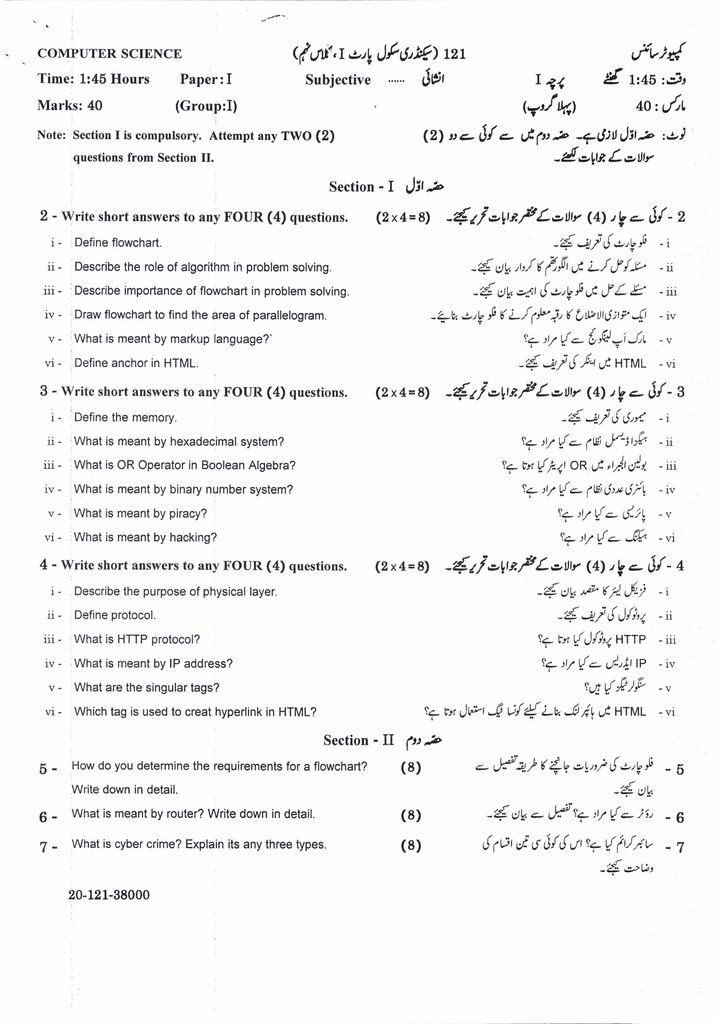
Section I — Short Questions
Question 2 (Attempt any 4; all 6 solved below)
- Define flowchart: A flowchart is a visual or graphical representation of an algorithm or step-by-step problem-solving process using standard geometric symbols (such as ovals, parallelograms, rectangles, and diamonds) connected by arrows to show control flow.
- Describe the role of algorithm in problem solving: An algorithm acts as a clear, finite set of unambiguous instructions that translates a problem statement into a logical sequence of steps before coding begins. It helps programmers verify correctness, optimize efficiency, and divide complex tasks into manageable operations.
- Describe importance of flowchart in problem solving: Flowcharts make complex logic easy to visualize, trace, and communicate to non-technical stakeholders. They simplify debugging and logic checking before writing code and serve as clear documentation when maintaining or updating a program.
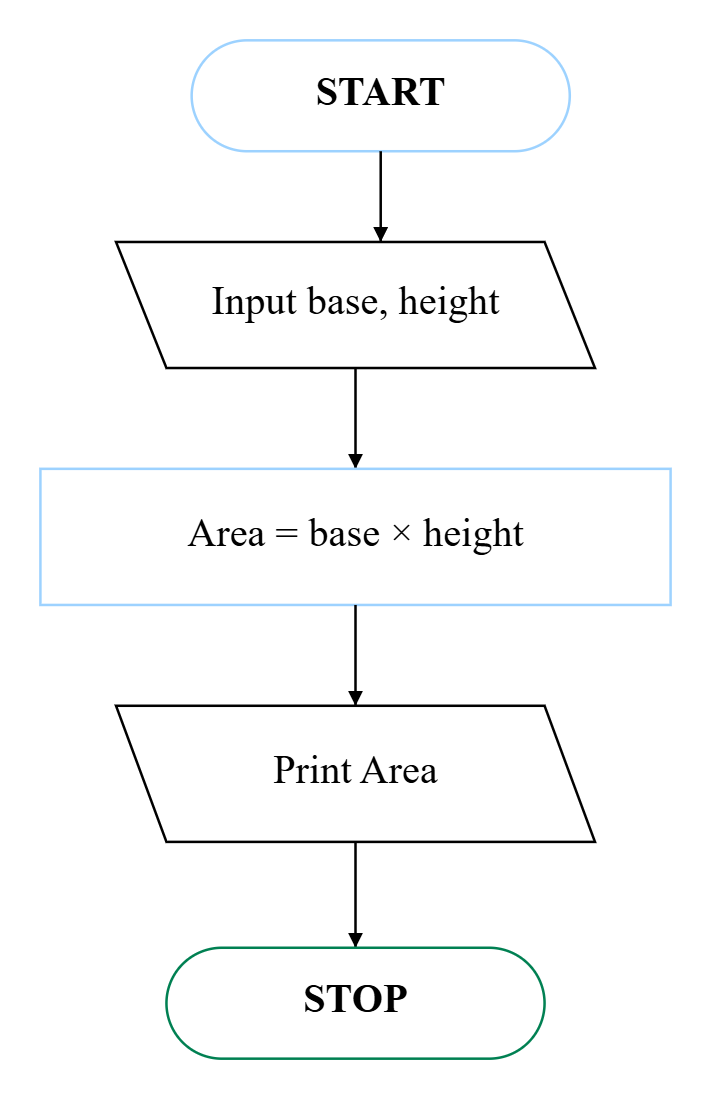
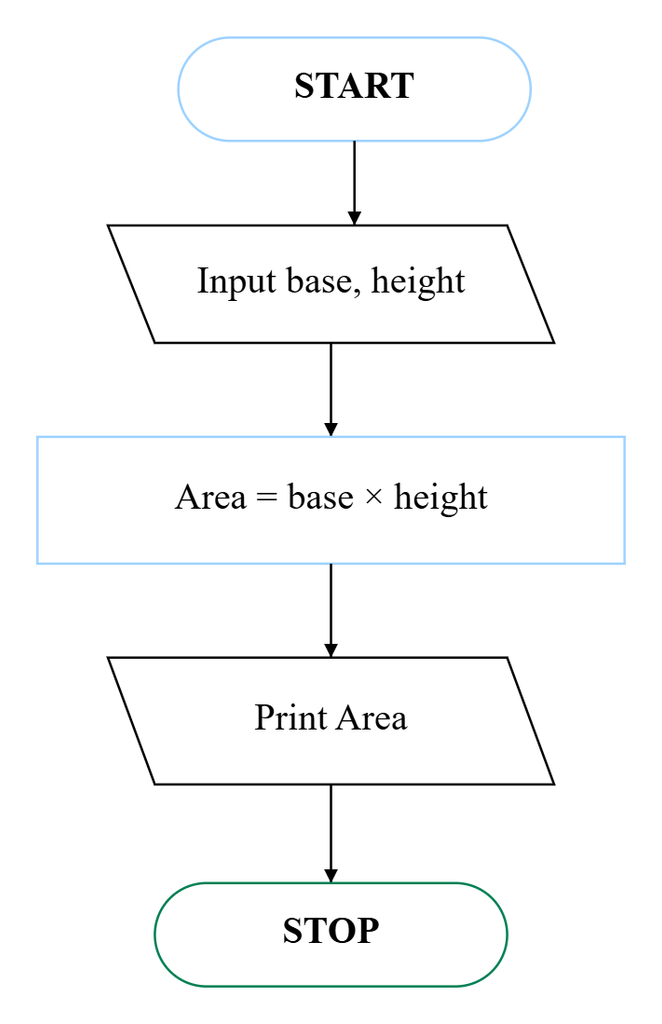
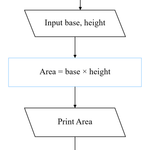
- Draw flowchart to find the area of parallelogram: Using standard formula $\text{Area} = \text{base} \times \text{height}$, the flow starts at a terminal oval, reads $\text{base}$ and $\text{height}$ in an input parallelogram, computes $\text{Area} = \text{base} \times \text{height}$ in a process rectangle, displays $\text{Area}$ in an output parallelogram, and ends at a terminal oval.SVGFlowchart for Calculating the Area of a Parallelogram
- What is meant by markup language? A markup language is a system of annotating text using tags or markers embedded within a document to define its structure, formatting, presentation, or semantics rather than executing general-purpose programming logic (for example, HTML and XML).
- Define anchor in HTML: In HTML, an anchor is a hyperlink or named target created using the tag (most commonly with the href attribute) to link from one web page or section to another resource, page, email address, or location.
Question 3 (Attempt any 4; all 6 solved below)
- Define the memory: Computer memory is a hardware storage component used to hold data, instructions, and intermediate results either temporarily (volatile memory such as RAM) or permanently (non-volatile memory such as ROM and secondary storage) for access by the processor.
- What is meant by hexadecimal system? The hexadecimal (base-16) number system uses sixteen distinct symbols—0 through 9 to represent values zero to nine and A through F (or a through f) to represent ten through fifteen—providing a compact representation of binary data.
- What is OR Operator in Boolean Algebra? The OR operator (often denoted by + or ∨) is a logical operation that outputs 1 (TRUE) if at least one of its input operands is 1, and outputs 0 (FALSE) only when all inputs are 0.
- What is meant by binary number system? The binary (base-2) number system represents numeric values and digital states using only two digits, 0 and 1 (called bits), where each digit position represents an increasing power of 2.
- What is meant by piracy? Software or digital piracy is the unauthorized copying, distribution, downloading, or use of copyrighted software, media, or digital content without paying for or obtaining a valid license from the copyright owner.
- What is meant by hacking? Hacking is the act of exploring, modifying, or gaining unauthorized access to computer systems, networks, or data; while malicious hackers (“black hats”) exploit vulnerabilities for harm or theft, ethical hackers (“white hats”) test systems to find and fix security weaknesses.
Question 4 (Attempt any 4; all 6 solved below)
- Describe the purpose of physical layer: The physical layer (Layer 1 of the OSI model) handles the transmission and reception of raw unstructured bit streams over a physical medium (such as copper cables, fiber optics, or radio waves), specifying electrical/optical signals, voltages, data rates, pinouts, and physical topology.
- Define protocol: A network protocol is a formal set of rules and conventions that governs how data is formatted, transmitted, routed, and received between communicating devices on a network so they can understand one another reliably.
- What is HTTP protocol? HTTP (HyperText Transfer Protocol) is an application-layer request-response protocol used on the World Wide Web to transfer hypertext documents (such as HTML pages), images, and other resources between web clients (browsers) and web servers.
- What is meant by IP address? An IP (Internet Protocol) address is a unique numerical identifier assigned to a device connected to a computer network that uses IP for communication, serving both to identify the host interface and locate it on a network (for example, IPv4 addresses like 192.168.1.1 or 128-bit IPv6 addresses).
- What are the singular tags? Singular tags (also called empty or self-closing tags in HTML) are tags that do not wrap content and therefore do not require a separate closing tag, such as
, , , and . - Which tag is used to creat hyperlink in HTML? The (anchor) tag with the href attribute is used to create a hyperlink in HTML, for example Visit Example.
Section II — Long Questions (Attempt any TWO; all 3 solved below)
Question 5: How do you determine the requirements for a flowchart? Write down in detail.
Determining requirements before drawing a flowchart ensures the chart accurately models the real problem rather than overlooking edge cases or producing wrong outputs. In problem analysis, requirements are systematically gathered and verified across five key dimensions:
- Inputs (Given Data): Identify all data items that must be supplied to the solution, including their names, data types, valid ranges, and units (for example, base and height for a parallelogram, or marks for each subject).
- Outputs (Expected Results): Clarify exactly what results must be produced and displayed or stored at the end of processing, along with how they should be formatted or labeled.
- Processing Rules and Formulas: Specify the mathematical equations, business rules, transformations, and sequence of operations needed to convert inputs into outputs, including order of evaluation and rounding rules.
- Decisions and Conditions: List every branching condition (such as pass/fail thresholds, validity checks, or comparisons) and define the exact path to take when a condition evaluates to true versus false.
- Loops, Termination, and Constraints: Determine whether any steps repeat, what condition stops a loop so it cannot run infinitely, and what boundary conditions or invalid inputs (such as zero or negative dimensions) must be handled.
Question 6: What is meant by router? Write down in detail.
A router is a networking device operating primarily at the Network Layer (Layer 3 of the OSI model) that connects multiple distinct computer networks—such as a local area network (LAN) and a wide area network (WAN) or the Internet—and forwards data packets between them.
- Packet Forwarding Based on IP Addresses: Unlike a switch that forwards frames within a single local network using MAC addresses, a router inspects the destination IP address in each incoming packet and forwards it toward the target network.
- Routing Tables and Path Selection: Routers maintain a routing table containing known network destinations, next-hop addresses, and interface choices; they build and update these paths using static configuration or dynamic routing protocols (such as RIP, OSPF, or BGP) to pick efficient routes.
- Interconnecting Different Networks: Routers bridge different network segments or technologies and isolate broadcast domains so broadcast traffic from one network does not flood other networks.
- NAT, Firewall, and Traffic Management: Many modern routers—especially home and edge gateways—perform Network Address Translation (NAT) to map multiple private local IP addresses to a public IP address, enforce basic packet filtering/firewall rules, and prioritize traffic via Quality of Service (QoS).
Question 7: What is cyber crime? Explain its any three types.
Cyber crime refers to illegal activities in which a computer, digital device, or computer network is either the primary target of the attack (such as breaching a server) or the instrument used to commit an offense (such as online fraud or identity theft).
- Phishing: A social engineering attack in which attackers send deceptive emails, text messages, or fake websites impersonating trusted organizations or banks to trick victims into revealing sensitive credentials, passwords, or financial details.
- Identity Theft: The unauthorized acquisition and misuse of another person’s personal identifying information—such as national ID numbers, bank account details, credit card numbers, or login credentials—to impersonate the victim, drain funds, or commit fraud in their name.
- Malware / Ransomware Attacks: Deploying malicious software—such as viruses, trojans, spyware, or ransomware—onto a system without consent to steal data, damage files, spy on activity, or encrypt critical files and demand payment for a decryption key.




Leave a Reply