
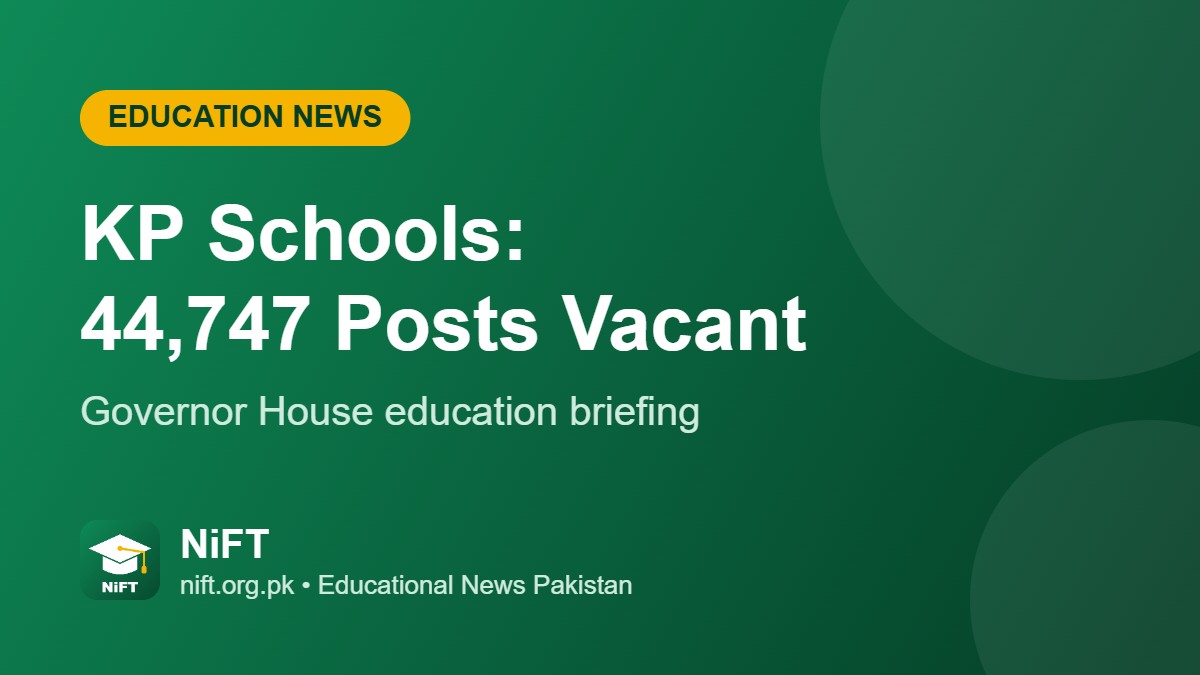
Khyber Pakhtunkhwa’s public schools are short of almost 45,000 teachers, and more than two dozen public universities are struggling to pay their way. These were among the figures presented at a special briefing on the province’s education sector, chaired by Governor Faisal Karim Kundi at the Governor House in Peshawar and reported on 18 November 2026 by the state news agency APP and Daily Jang.
The presentation was given by the Governor’s Adviser on Education, Dr Syed Aamir Abdullah, to provincial advisers, departmental secretaries and journalists. It covered schools, colleges and universities, along with reform plans the government says are under way.
KP School Education in Numbers
| Indicator | Figure presented |
|---|---|
| Public schools | 34,848 |
| Students in public schools | About 5.96 million |
| Teachers in post | 187,159 |
| Vacant teaching posts | 44,747 (8,837 of them in the merged districts) |
| Schools with only one or two teachers | 11,617 (Daily Jang) |
| Average students per teacher | 41 (Daily Jang) |
| Out-of-school children | About 4.9 million (Daily Jang) |
One figure needs care. Daily Jang’s report gives the number of non-functional government schools as 563 in one paragraph and 329 in another, and APP’s report gives no count at all. Until the Elementary and Secondary Education Department publishes the number, treat both figures as unconfirmed.
Learning results were the most worrying part of the briefing. According to Daily Jang, 83% of children tested in the districts could not read a sentence in English, 82% could not read a paragraph in Urdu, and 60% could not solve basic addition and subtraction.
Colleges and Universities
| Sector | Figure presented |
|---|---|
| Public universities and institutions | 34, with 160,587 students |
| Government colleges | 388, with 280,777 students |
| Universities facing financial difficulty | 26 |
| Combined deficit of 14 institutions | Rs 5.6 billion |
| Support requested from HEC | Rs 18 billion |
A high-level working group has been formed to deal with university finances and governance, according to APP.
What the Government Says It Is Doing
- A revised e-transfer policy for merit-based teacher posting, plus staff rationalisation.
- Real-time teacher attendance monitoring through EMIS, and a 100-day teacher training plan.
- Solar power for 424 schools, 15 middle and high schools to become model schools, IT labs, and an education internship programme with 500 interns.
- Outsourcing of 1,500 schools in a second phase, and an enrolment drive for out-of-school children in 12 priority districts.
- Under the Prime Minister’s initiatives, Rs 16.5 billion for 11 education, IT and skills projects, including seven Danish Schools and digital libraries in four districts.
No timelines or district lists were shared publicly for most of these steps.
What This Means for Students, Parents and Job Seekers
- Teaching job aspirants: 44,747 vacancies is a large number, but the briefing did not announce a recruitment drive. Rely only on advertisements from the E&SE Department or its official testing agency, and ignore social-media “job lists” that ask for fees.
- Parents: If your child’s school has one or two teachers covering several classes, raise it with the district education officer. Teacher rationalisation is meant to address exactly this.
- University students: Financial pressure can delay salaries, fee decisions and scholarships at some campuses. Keep an eye on your university’s official notices before paying revised fees.
Similar reform debates are going on elsewhere. See our coverage of Islamabad’s planned education authority and Punjab’s school education updates.
Source: Governor House Peshawar briefing as reported by Associated Press of Pakistan (APP, 18 November 2026); first seen in Daily Jang (18 November 2026). Figures are as presented at the briefing and have not yet been published in an official department report.



Leave a Reply