
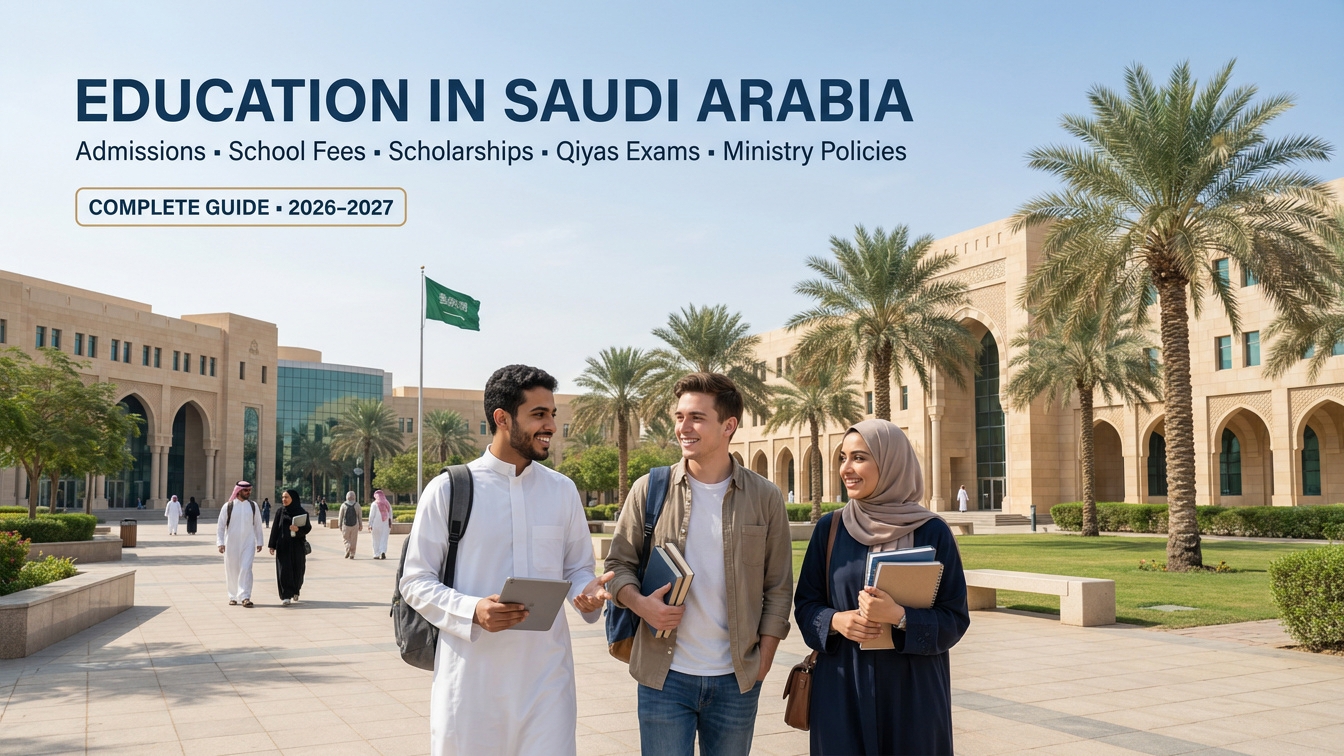
Finding clear, current information about education in Saudi Arabia can be frustrating. Official portals from the Ministry of Education (MOE) and the Education and Training Evaluation Commission (ETEC) contain most of what you need, but the details are often scattered across Arabic-language sites or spread between different institutional pages. Whether you are an expatriate parent trying to enroll a child in an international school, a high-school graduate preparing for university entrance exams, or an international student looking for a fully funded scholarship, this guide pulls the key information together for the 2026–2027 academic cycle.
It covers school admissions, typical fee ranges, the Qudurat and Tahsili tests, degree equivalency (Muadalah), and both external and internal scholarship routes.
1. School Admissions and the Noor System in Saudi Arabia
School enrollment for families living in the Kingdom is handled through the Ministry of Education’s Noor System. Knowing the timelines, age cut-offs, and document requirements helps avoid last-minute problems during peak registration periods.
How the Noor System works
The Noor portal (noor.moe.gov.sa) is the single platform used by public, private, and international schools. Parents use it to:
- Register children for Kindergarten and Grade 1
- Request transfers between schools in the same city or different regions
- Check attendance, semester grades, and digital report cards
To register a new student, log in with your Nafath credentials, select “Registration of Children,” confirm the family members linked through Absher, choose a school (usually by location or curriculum), and upload the required medical and residency documents.
Minimum age requirements for KG and Grade 1
The Ministry applies fixed age cut-offs tied to the start of the academic year (normally late August):
- KG 1 (Nursery): 3 years old and under 4
- KG 2 (Junior KG): 4 years old and under 5
- KG 3 (Senior KG / Prep): 5 years old and under 6
- Grade 1: at least 6 years old on the first day of classes. A limited grace period of up to 90 days (children aged 5 years and 9 months) is usually allowed if the child has an accredited KG completion certificate from a recognized school.
Documents needed for expatriate admissions
Expat parents must prepare both digital copies for the Noor upload and physical attested copies for the school:
- Valid Iqama for the student and the father/sponsor
- Passport copies for the student and parents (including the entry stamp if the child recently arrived)
- Birth certificate translated into Arabic or English and attested by the Saudi Embassy in the home country and the Saudi Ministry of Foreign Affairs (MOFA)
- Vaccination certificate stamped by a Saudi Ministry of Health primary healthcare center (required for KG and Grade 1)
- For Grade 2 and above: previous school records and a Transfer Certificate attested by the relevant educational board, the Saudi Cultural Attaché, and MOFA
Transferring a child between schools
Transfers are handled electronically through Noor during the official windows before each term:
- Obtain a Financial Clearance Certificate from the current school confirming all fees are paid.
- Log into the parent Noor account and submit a Student Transfer Request.
- Select the target school (check seat availability first).
- The current principal releases the student electronically; the receiving principal accepts. Once both approvals are in place, the student’s digital file moves automatically.
2. International and Community School Fee Structures (2026–2027)
Tuition varies a great deal depending on the curriculum (British, American, IB, Indian CBSE, Pakistani FBISE, or Philippine), the city (Riyadh, Jeddah, Dammam/Khobar), and the grade. Note that 15% VAT is added to tuition for non-Saudi students; Saudi nationals are exempt.
Typical annual tuition ranges (excluding VAT, books, uniforms, and transport)
| School Category / Curriculum | Examples | Annual Tuition Range (SAR) | Registration / Assessment Fee |
|---|---|---|---|
| Embassy / Community Schools (Pakistani, Indian, Filipino) | Pakistan International School (PISJ/PISR), International Indian School (IISR/IISJ) | 4,500 – 9,500 | 300 – 1,000 |
| Mid-Tier International (British / American) | Al Yasmin International, Manarat Schools, Al Rowad International | 14,000 – 28,000 | 1,000 – 2,500 |
| Premium International & IB | British International School Riyadh (BISR), American International School (AISR/AISJ) | 45,000 – 95,000+ | 3,000 – 7,500 |
Additional costs parents should budget for
Base tuition is only part of the picture. Expect:
- 15% VAT on every tuition installment for expat students
- Books and digital resources: roughly 800 – 3,500 SAR per year
- School transport: 2,500 – 6,000 SAR annually depending on distance
- Uniforms (usually 400 – 800 SAR) and mandatory student medical insurance under Iqama rules
Can expatriate children attend Saudi public schools?
Public schools are generally reserved for Saudi nationals and GCC citizens. Limited exceptions exist for children of non-Saudi mothers married to Saudi men, children of diplomats, and some expatriates working in government ministries or public universities, subject to seat availability and MOE approval.
3. Standardized Entrance Exams: Qiyas, Qudurat (GAT), and Tahsili (SAAT)
Any student finishing high school in Saudi Arabia—Saudi or expatriate—who wants to enter a public or private university must sit the standardized tests run by Qiyas (National Center for Assessment under ETEC).
Difference between Qudurat (GAT) and Tahsili (SAAT)
Universities use both scores when calculating the composite admission score (Al-Nisbah Al-Mawzoonah):
| Feature | General Aptitude Test – GAT (Qudurat) | Standard Achievement Admission Test – SAAT (Tahsili) |
|---|---|---|
| Purpose | Analytical, mathematical, and verbal reasoning | Subject knowledge from high-school courses |
| Subjects | Quantitative (Algebra, Geometry, Arithmetic, Data Analysis) and Verbal (Reading, Analogy, Sentence Completion) | Mathematics, Physics, Chemistry, Biology (Grades 10–12) |
| Eligibility | Grade 11 and Grade 12 students | Grade 12 students and high-school graduates |
| Attempts | Up to 5 (computer-based and paper-based combined); highest score is used | Usually 2 main testing windows per year (computer-based) |
| Language | Arabic and English | Arabic and English |
Registering for the English versions
Students in British, American, Indian, or Pakistani curriculum schools can take both exams in English:
- Go to the ETEC Qiyas portal (e-services.etec.gov.sa) and create an account with your Iqama number.
- Complete profile verification and upload a compliant photograph.
- Select “General Aptitude Test (English)” or “Standard Achievement Admission Test (English)”—make sure you do not choose the Arabic version by mistake.
- Pick a test center (Riyadh, Jeddah, Dammam, Makkah, Madinah, Abha, Tabuk, etc.), choose a date, and pay the fee (normally 100–150 SAR via SADAD or Mada).
Study materials and target scores
Qiyas does not publish full past papers after every session. Useful preparation sources include:
- Free sample questions and exam blueprints on the ETEC website
- Computer-based question banks (Tajmi’at) that collect recalled questions from recent cycles
- Solid coverage of SAT Math and Grade 11–12 science concepts for the English versions
A score of 75+ is competitive for many general programs. Medicine, Engineering, Computer Science, and top scholarships at King Saud University or KFUPM usually require 85–95+.
How the composite score (Nisbah Mawzoonah) is calculated
Most universities combine:
- High School GPA (Thanawiyah): 30%
- GAT (Qudurat): 30%
- SAAT (Tahsili): 40% (especially for STEM and medical colleges)
Example: 96% high-school average, 88 in GAT, 85 in SAAT
(96 × 0.30) + (88 × 0.30) + (85 × 0.40) = 28.8 + 26.4 + 34.0 = 89.2%
4. Degree Equivalency (Muadalah) and Certificate Attestation
Anyone moving from a foreign curriculum school inside Saudi Arabia or presenting credentials earned abroad will need Muadalah (official academic equivalency).
Who needs Muadalah
You need it if:
- You completed Grades 10–12 in an international curriculum (IGCSE/A-Levels, American Diploma, CBSE, FBISE) and are applying to a Saudi university
- You hold a Bachelor’s, Master’s, or PhD from outside Saudi Arabia and are applying for postgraduate study, professional licensing (Saudi Council of Engineers, SCFHS, etc.), or government/academic employment
High-school equivalency requirements
- British (IGCSE / O & A Levels): At least 5 O-Level subjects and 2 AS-Level (or 1 full A-Level) with grades A*–D (or 9–4). Specific science or math subjects may be required depending on the stream; Arabic/Islamic studies rules vary by nationality.
- American Diploma: Complete Grades 9–12 transcripts from an accredited school plus qualifying SAT/ACT and Qudurat/Tahsili scores as required by the MOE.
- Indian (CBSE) / Pakistani (FBISE): Attested Grade 10 and Grade 12 mark sheets and certificates.
Applying for university degree equivalency online
Applications go through the Ministry of Education’s Muadalah portal (eqs.moe.gov.sa):
- Confirm the university appears in the MOE Recommended Universities Directory (Safeer database – ru.moe.gov.sa).
- Prepare attested documents: original degree and full transcripts, attestation from the home country’s Ministry of Foreign Affairs and the Saudi Cultural Attaché, official Arabic translation if needed, and proof of residency/visa during the study period (distance-only degrees are rarely accepted).
- Log in with Nafath, upload the scanned files, and track the review. Processing usually takes 4–8 weeks.
5. Scholarships in Saudi Arabia: External and Internal Pathways
Saudi Arabia remains one of the larger providers of fully funded scholarships. Vision 2030 has increased the focus on attracting international talent.
Study in Saudi portal
The Ministry of Education’s centralized platform (studyinsaudi.moe.gov.sa) lets international students outside the Kingdom create one profile and apply to scholarships at more than 25 public universities, including:
- King Saud University (Riyadh)
- King Abdulaziz University (Jeddah)
- Islamic University of Madinah
- Umm Al-Qura University (Makkah)
- King Khalid University (Abha)
- Imam Abdulrahman Bin Faisal University (Dammam)
- Princess Nourah bint Abdulrahman University (Riyadh – female students)
What government scholarships typically cover
Accepted students usually receive:
- Full tuition waiver for the entire program
- Monthly stipend (approximately 850–900 SAR for undergraduates; higher, often 900–2,500+ SAR, for postgraduate researchers at places such as KAUST or KFUPM)
- Furnished on-campus housing or a housing allowance
- Annual round-trip airfare
- Medical care at university hospitals
- Arrival and graduation allowances
Internal scholarships for expatriate residents
Non-Saudi students holding a valid Iqama can apply for Internal Scholarships (Minah Dakhiliyah) at public universities. Requirements generally include a valid Iqama, a Saudi high-school certificate or accredited equivalency, a competitive composite score, and an age limit (usually under 25 for Bachelor’s programs). These scholarships cover tuition and provide a monthly stipend but normally do not include international airfare or campus housing, since the student already lives in the Kingdom with family. Applications are submitted through each university’s admission portal in the summer window (June–July) or via the internal track on the Study in Saudi platform.
English-taught programs
STEM, Business, and many Medical programs at major universities are taught entirely in English. Notable examples:
- KAUST (postgraduate research university) – 100% English; requires IELTS 6.5+ or TOEFL, not Qiyas
- KFUPM – Engineering, computing, and business; English instruction; accepts SAT/IELTS as well as local Qiyas tracks
- King Saud University and King Abdulaziz University – English-medium tracks in Engineering, Computer Science, Medicine, Pharmacy, and Business Administration
6. Key Ministry of Education Policies
Compulsory education
Education is compulsory for all children aged 6 to 15 (Primary and Intermediate stages), regardless of nationality. Parents who fail to enroll school-age children or allow long unexcused absences can face inquiries through child-protection and MOE welfare committees.
Three-semester academic calendar
The Kingdom now uses a structured calendar with clear breaks between terms (mid-term, Founding Day, National Day, Eid Al-Fitr, and Eid Al-Adha). Private and international schools follow the Ministry’s overall start and end dates while adjusting examination schedules to match British, American, or South Asian board calendars.
Madrasati platform
Madrasati (schools.madrasati.sa) remains linked to the Noor System. Teachers continue to use it for digital homework, supplementary materials, virtual classes during weather-related suspensions, and communication with parents.
Official Portals & Resources
Always check the official sites for the latest admission dates, fee rules, and deadlines:
- Ministry of Education: moe.gov.sa
- Noor Student Management System: noor.moe.gov.sa
- Study in Saudi Scholarship Portal: studyinsaudi.moe.gov.sa
- ETEC / Qiyas Testing Center: etec.gov.sa
- Academic Equivalency (Muadalah) Portal: eqs.moe.gov.sa
- Safeer Accredited Universities Directory: ru.moe.gov.sa




Leave a Reply